Experiment 04
Reaction-diffusion
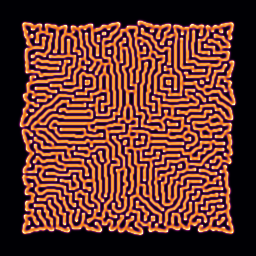
Two chemical substances, one local rule for who feeds whom and who kills whom, repeated across a whole grid — and spots, stripes, or a maze appear with no blueprint ever drawing them.
What is Gray-Scott?
Gray-Scott is a reaction-diffusion system: two chemical substances, U and V, occupy every point of a grid and diffuse toward their neighbours at different rates (Du, Dv). A local reaction couples them: V consumes U to reproduce itself (the U·V² term), while a feed rate F replenishes U and a kill rate k removes V. It is a special case of the equation Alan Turing proposed in 1952 to explain morphogenesis — how an initially uniform embryo develops patterns (a coat's spots, a fish's stripes) from two substances diffusing at different rates.
From the values of F and k alone, this same mechanism produces radically different regimes: isolated spots, stripes, a maze of walls, or spots that split in two (mitosis). LifeLabs exposes four presets calibrated on these regimes, but the boundary between them is continuous — nudging F or k by one hundredth is enough to tip the grid from one pattern to another.
Why this is emergence — a pattern, not a creature
In Lenia, emergence produces a mobile isolate: a shape that moves as a whole, somewhat like an organism. Here, emergence produces a global pattern, spatially stable once it settles: the same reaction-diffusion rule, applied identically at every point of the grid, gives rise to a regular tiling of spots or stripes — with no notion of position or distance ever entering the computation. The pattern is a pure product of repeated local chemistry, never written into the equations themselves.
LifeLabs therefore does not speak of a "creature" for Gray-Scott: nothing here moves as a coherent whole, nothing pulses or reproduces at the scale of a single isolate. The right word is "pattern", in Turing's sense: a texture that self-organizes out of an initially near-uniform field, then stays largely static afterward. This is a quieter wonder than Lenia, but just as rigorous: a bare-bones chemical system, with no memory of shape, that nonetheless produces geometric regularity.
Pilot
Pilot the reaction
The vital signs we measure
Each run records five time series, computed at regular intervals during the simulation, which serve as "vital signs" for the observed pattern:
- Active fraction
- the proportion of cells where V exceeds an activity threshold — it climbs while the reaction spreads across the grid, then levels off once the pattern has settled.
- Spatial variance
- the variance of V's values across the whole grid — near zero for a uniform field, it rises sharply as soon as a spot or stripe pattern structures itself; the most direct signal that "something is happening".
- Pattern entropy
- the Shannon entropy of the histogram of V's active values — a measure of how varied the intensities within the pattern are, distinct from its geometry.
- Interface density
- the mean gradient magnitude of V between neighbouring cells — dense along a pattern's sharp boundaries, near zero on a constant field.
- Mass of V
- the total sum of V across the grid — a mass converging to a plateau signals a stabilized pattern, a mass that keeps growing indicates a reaction still expanding.